Move iron a week ahead
Dispatch, hauling, rentals and fuel planned as one connected chain.
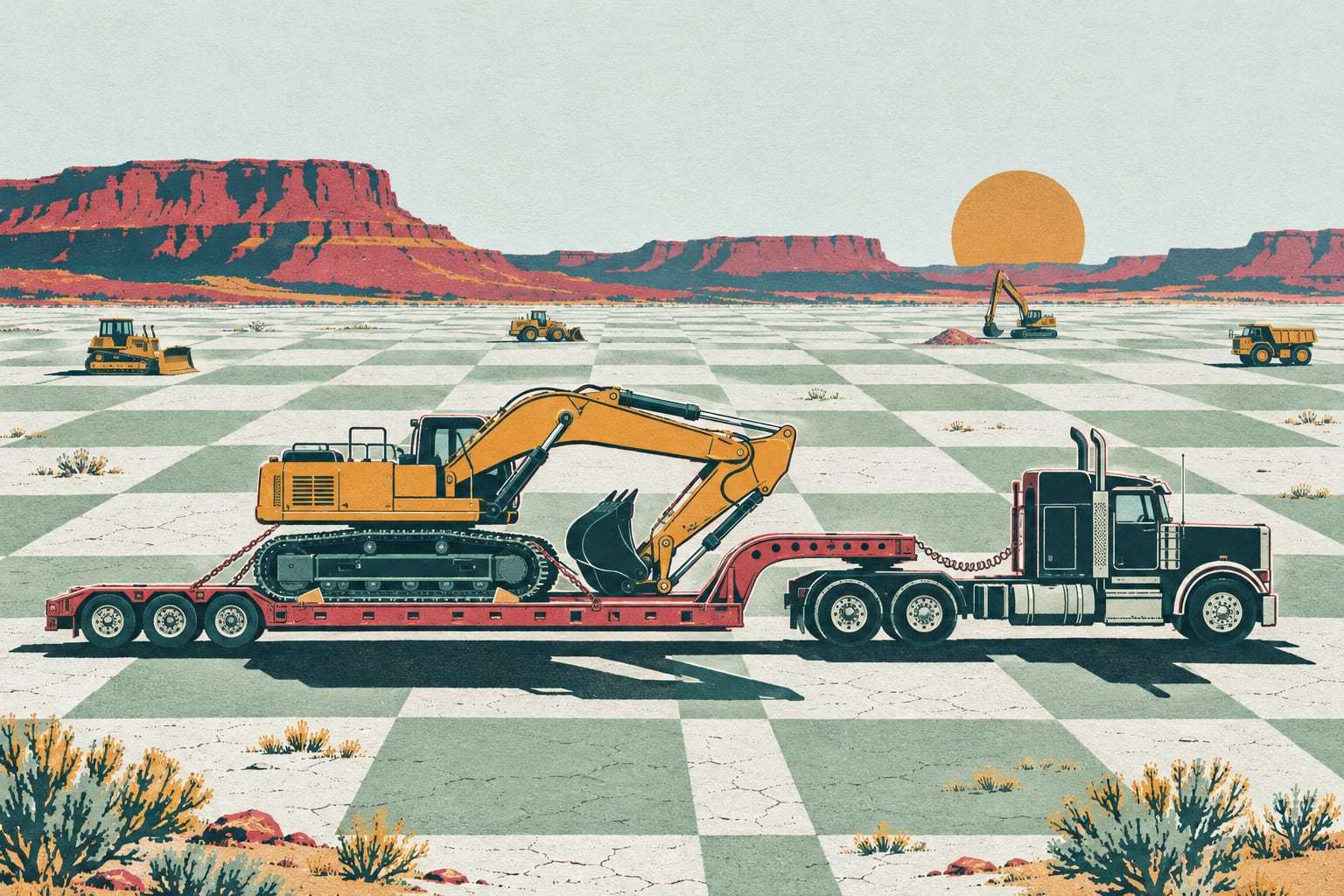
Every machine move touches four things: is it fit to go, who hauls it, which rental it replaces, how it gets fuel. Fleet logistics puts them on one board, so Monday’s plan still holds on Thursday.
The magnet board cannot see service
Dispatch usually runs on a magnet board, a group text and the lowboy driver’s memory. The board does not know the excavator is 20 hours from its 1,000-hour service, so it ships to a job and comes straight back. Meanwhile a rented loader keeps billing for a week after the owned one is free, and the fuel truck finds out last.
What moves without a phone call
Service blocks dispatch
A machine inside its service window cannot be assigned to a job until the shop clears it.
Lowboy moves planned
Each move has a date, a driver, a load width and height, and a backhaul where one exists.
Rentals called off
When an owned machine frees up, the rental it covered is flagged for call-off that day.
Fuel matched to machines
Gallons delivered are set against each machine’s engine hours, so a mismatch shows up that week.
Ways to run dispatch
Command plan
Dispatch and haul planning, rental tracking, fuel and emissions, plus everything in the Shop and Field plans.
Small fleet dispatch
Fleets that mainly need the dispatch board run it on Command. Below 25 machines, onboarding is a flat fee.
Rental tracking
Machines rented from any rental company sit beside your own, with rate, start date, call-off date and hours.
Fuel and emissions reports
Gallons by machine and job, matched to engine hours, with CO2 calculated from the EPA’s diesel factor.
What the dispatch board holds
Board by job
Every machine, owned or rented, in a column by job. The dispatcher drags it to the next one.
Service holds
Machines inside their work order window show a hold until a mechanic releases them.
Move planning
Origin, destination, trailer, load width and height, and a flag when the load needs an oversize permit.
Rental ledger
Rate, start date, call-off date and hours used for every rented machine, by job.
Fuel by machine
Fuel truck tickets and tank logs matched to machines and jobs, checked against engine hours.
Driver app, offline
Lowboy drivers see the day’s moves in English or Spanish, with or without signal.

Example: a 120‑machine earthworks fleet in Phoenix
An earthworks contractor runs 120 machines and three lowboys from a yard in the West Valley, with jobs in Buckeye, Casa Grande and Queen Creek. On Monday the board shows a dozer at Buckeye 30 hours from its 1,000-hour service, so it carries a hold. Friday’s lowboy takes a compactor out to Buckeye and brings the dozer back, loaded both ways. A rented dozer covers the gap, its call-off date set for the day the owned one returns, and its fuel is logged against its hours on the Buckeye job.
How the chain holds together
Service decides who travels. A dispatch board that cannot see the shop sends out machines that should be coming in. In Gytix, every machine carries its service status onto the board. Inside the work order window it shows a hold; past the interval it cannot be assigned until a mechanic signs it off. The dispatcher sees why a machine is held, and the superintendent sees the day it will be back on the job.
Loads, permits and backhauls. Each move records the trailer, the machine’s transport width and height, and the route. New Mexico State Police policy sets the legal width at 8 feet 6 inches and requires an oversize permit for a vehicle and load over 14 feet high, so a move past either line is flagged before a driver is booked. Pairing a delivery with a backhaul turns two empty runs into one loaded round trip. Confirm permit needs with the state agency for every route.
Rentals and fuel close the loop. A rental starts billing when the machine arrives and stops only when someone calls it off. The board pairs each rental with the owned machine it covers, so the call-off date appears the moment the owned one is released. Fuel works the same way: gallons delivered are matched to each machine’s engine hours, and the EPA’s GHG Emission Factors Hub figure of 10.21 kilograms of CO2 per gallon of diesel turns them into an emissions report by job.
Dispatch questions, answered
What does equipment dispatch software do?
It assigns machines to jobs and plans the moves between them. In Gytix the dispatch board also knows each machine’s service status, the lowboy schedule, the rentals on each job and the fuel delivered, so one change on the board updates the rest of the week’s plan.
Can a machine that is due for service be blocked from dispatch?
Yes. When a machine enters its work order window, it shows a hold on the dispatch board, and once it passes the interval it cannot be assigned until a mechanic signs it off. Your shop sets the window per service plan; the default is 50 engine hours.
Does Gytix track equipment rented from other companies?
Yes. Machines from any rental company go on the same board as owned ones, with rate, start date, call-off date and hours. Position comes from the machine’s own feed where the rental company shares it, or from a B1 tracker your crew moves from one rental to the next.
Do we need the Command plan for dispatch?
Yes. Dispatch and haul planning, rental tracking and fuel and emissions reports are part of the Command plan, priced per connected machine per month, month to month. Command also includes the AI maintenance agent, the full API and single sign-on, and onboarding is included for fleets of 25 machines or more.
Can lowboy drivers use the app without cell signal?
Yes. Drivers see the day’s moves, load details and destinations in the mobile app, in English or Spanish, and the app works offline. Pickup and drop-off times sync when the phone reconnects, so the dispatch board updates without a call from the cab.
Bring us next week’s moves
Send the fleet list you already keep. We will say plainly whether fleet logistics is the right place to start.