Ready before the harvest window opens
Track tractors, loaders and irrigation pumps across fields, orchards and dairies.
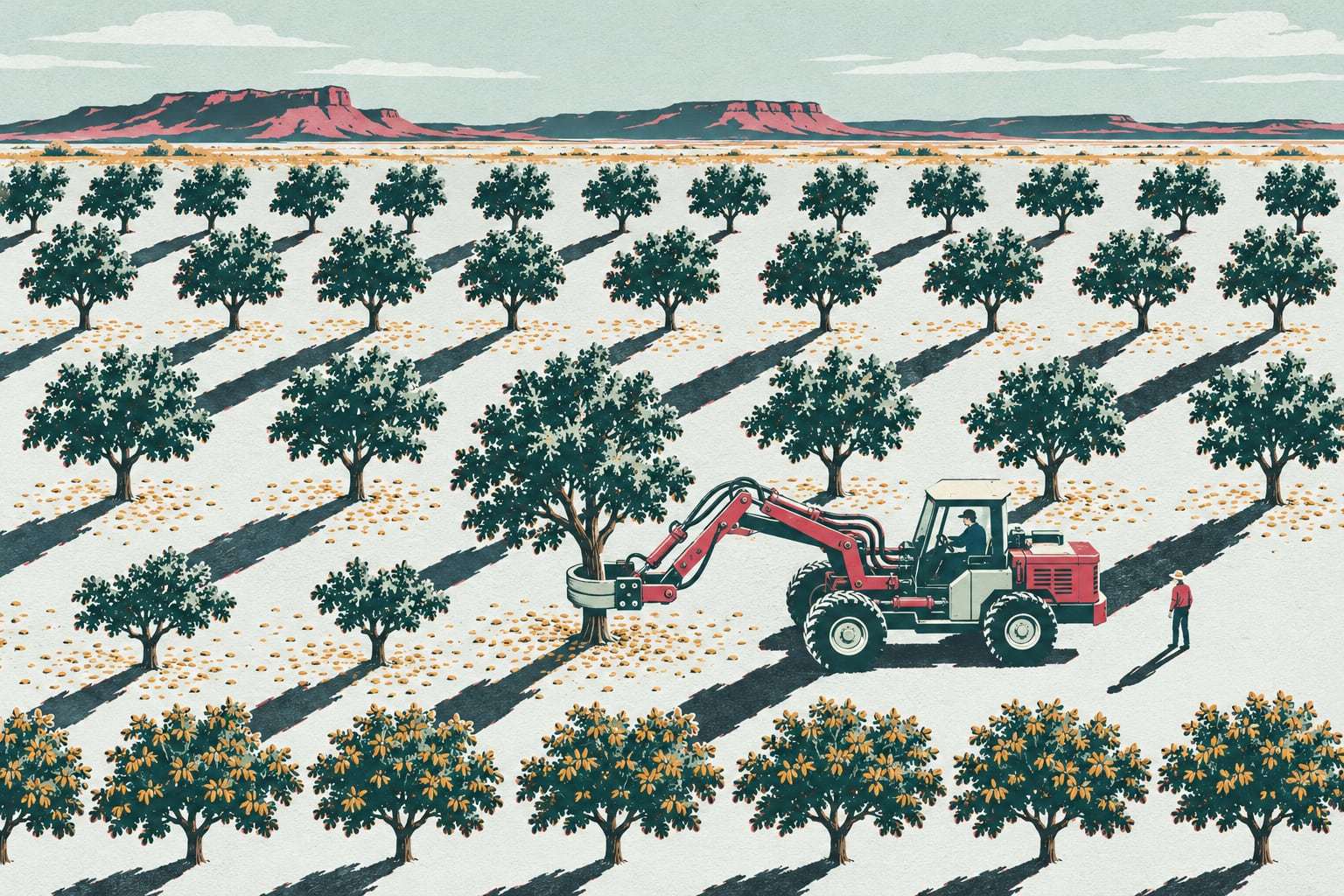
A tree shaker that breaks in the middle of pecan harvest costs more than the repair, because the nuts wait on the ground. Gytix tracks hours on tractors, loaders, shakers and pump engines, and moves the big services into the slow months.
Where a season slips away
Breakdowns in harvest week
A shaker, a harvester or a chile trailer down in harvest week costs days you cannot get back.
Seasons, not calendars
Equipment runs 60 hours a week in season and sits for months, so calendar service misses both.
Pumps run unwatched
Irrigation pump engines and generators run overnight at the far end of the farm, with no one nearby.
Dairy iron never rests
Feed loaders and skid steers at a dairy work every day of the year, often twice a day.
What a farm or dairy connects
Preventive maintenance
Service by engine hours, with the big services planned for the slow months before harvest.
Asset health monitoring
A pump engine that logs a fault code at night sends it straight to the irrigator’s phone.
Parts and inventory
Belts, filters and hoses on min/max, stocked before the season instead of overnighted during it.
Field services
Installs in the slow season, with crew training in English or Spanish on your own ground.
Set up in the slow season
- Week 1
Walk the farm
We list tractors, loaders, harvesters, pumps and generators, with hour meters and last service dates.
- Month 1
Engines and pumps online
A1 gateways on engines, B1 trackers on trailers and implements, and inspections in English or Spanish.
- Month 3
Pre-harvest services booked
Every machine’s pre-season service is scheduled by hours, with parts on the shelf before the window.
Seasons, hours and the window
Hours, not the calendar. Farm equipment runs in bursts. A tractor might log 600 hours between planting and harvest and almost none in between, while a dairy feed loader runs every day of the year and a swather works long days for a few weeks each cutting. Gytix reads engine hours from each machine, or ignition time on older tractors, so a service falls due when the machine has done the work, not on a date that ignores the season.
Plan the big services for the slow months. Each crop sets its own window: chile from August into October around Hatch, pecans from November into January in the Mesilla Valley, winter vegetables around Yuma. The service forecast shows which machines will cross a 500 or 1,000-hour interval during harvest, so the shop can do those services early, with the parts already on the shelf. The PM interval planner gives a starting point.
Pumps and generators at the edge. Irrigation wells and the generators that power them sit at the far corners of a farm, often out of cell range. An A1 gateway logs run hours and fault codes and stores 30 days of data, and the A1S sends them by satellite every 15 minutes. A pump engine that stops on a fault at 2 a.m. reaches the irrigator before the field misses a set.
Farm and dairy questions, answered
How does farm equipment tracking work on older tractors?
An A1 gateway reads hours and engine data from any tractor with a J1939 engine controller. On older tractors without one, it logs run time from the ignition and position by GPS. Tractors that already report through a manufacturer feed connect without any Gytix hardware, and every tractor shows on one map.
Can you track irrigation pump engines and generators?
Yes. A diesel pump engine or generator with an engine controller takes an A1 gateway, which reports run hours, fuel and fault codes. If the well has no cell signal, the A1 stores 30 days of data, or the A1S sends position, hours and faults by satellite every 15 minutes.
Is tracking worth it for machines used only a few months a year?
It is for the machines a harvest depends on. On the Field plan, tracking runs month to month per connected machine, and the hours show which services are truly due before the window opens. Light assets such as trailers and implements can carry a B1 tracker, billed per asset per month. Your written quote, after a walkthrough on your own fleet list, shows what a year of tracking comes to.
Do you install on farms in southern New Mexico and Arizona?
Yes. Our field crews install across New Mexico, including Hatch, Las Cruces, Deming and the Mesilla Valley, and across Arizona from Casa Grande to Safford and the Yuma area. Installation is charged per machine installed. Travel is included in New Mexico, and outside the state we quote a flat trip fee first.
Can dairy loaders run on a different schedule from field equipment?
Yes. Each machine runs its own service plan on its own engine hours. A dairy feed loader working every day reaches its 500-hour service far sooner than a tractor used for planting and harvest, and each work order opens 50 hours ahead of its own interval, with the parts listed.
Show us how your fleet runs
Send your fleet list. A 45-minute walkthrough on your own machines, then a written quote.