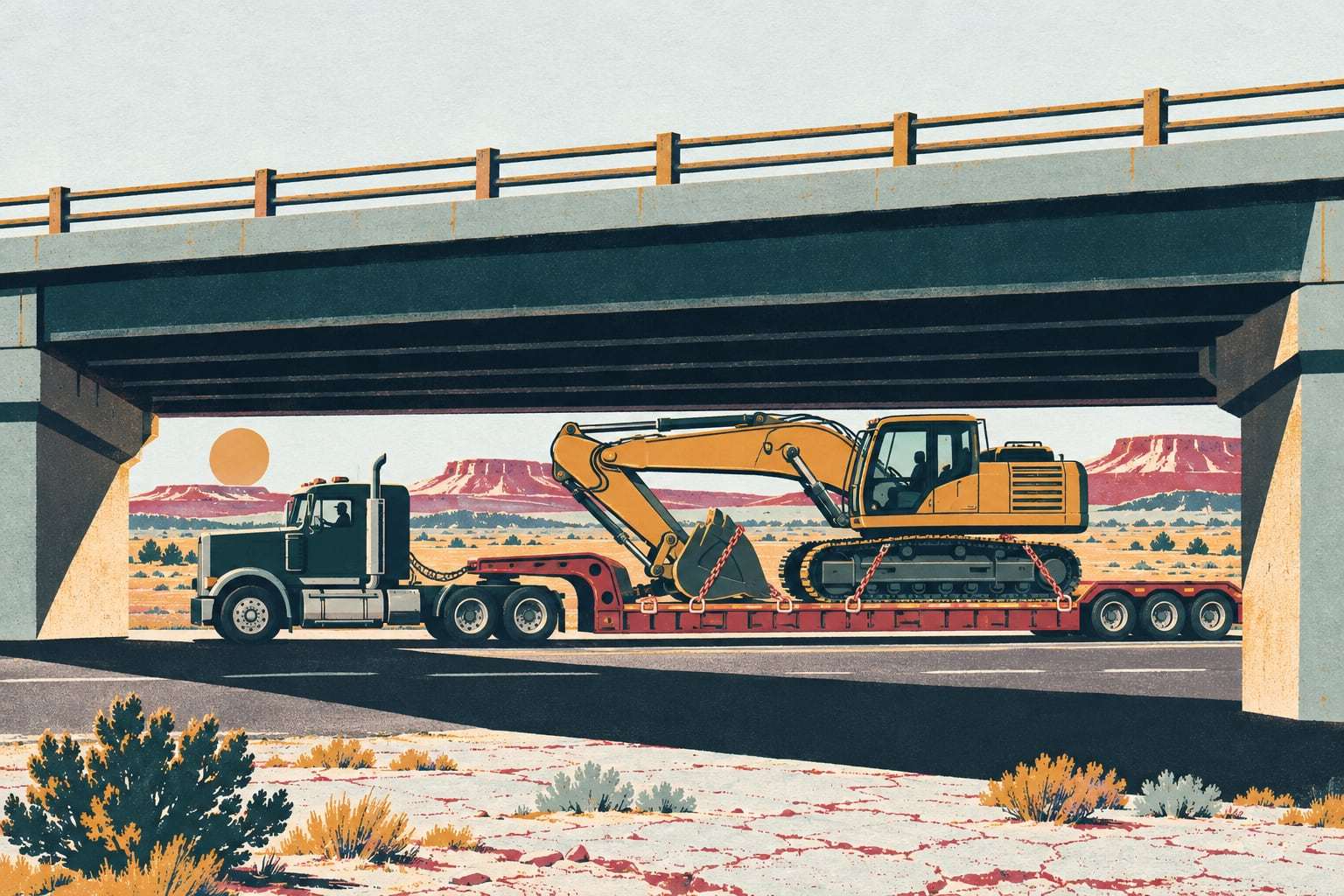
Most lowboy delays are planning failures that surface at an overpass, a scale or a locked gate. Measure the load, permit the route, survey the clearances and fill the trip home before anyone throws a chain.
Measure the machine as loaded
The number that matters is the height of the machine sitting on your deck, not the figure on the spec sheet. A spec sheet assumes a boom position, a cab guard, a bucket and track shoes that may not match the excavator in your yard.
The formula is short:
Loaded height = deck height under load + machine height as it will ride + any cribbing
Worked example. A lowboy deck sits about 2 feet off the road with the machine on it. The excavator measures 10 feet 6 inches to the top of its cab guard with the boom folded the way it will travel. Loaded height is 12 feet 6 inches. Add a hydraulic thumb that forces the boom a foot higher and you are at 13 feet 6 inches, close to the line where New Mexico requires a permit.
Measure width at the widest point as loaded: blade, bucket, track shoes, steps, mirrors and handrails. A dozer blade or a wide cleanup bucket is often the widest thing on the trailer. Taking it off and hauling it separately can turn an oversize load into a legal one.
Weight matters most on bridges and lease road crossings. Add the tractor, the trailer, the machine and every attachment riding on the deck. Then compare gross and axle weights with the limits published for that route and axle layout.
What New Mexico sets as legal
Start with the state’s own numbers. New Mexico State Police policy sets the legal width at 8 feet 6 inches and requires an oversize permit for a vehicle and load over 14 feet high. A load wider than that legal width, or taller than 14 feet, is an oversize move.
Those two numbers are the starting line, not the whole rulebook. A permit can carry conditions on travel hours, days of the week, holidays, the route, escort vehicles, signs, flags and lights. The conditions change with the size of the load, so read each permit itself rather than trusting last month’s.
Every state writes its own rules. A move from a yard in Hobbs to a lease near Midland crosses into Texas, where the Department of Motor Vehicles issues oversize permits. Arizona and Colorado issue theirs through their state transportation departments. Confirm the rules with the permitting agency for each state and each route before you promise a superintendent a delivery date.
Survey the route, not the map
A permit approves a route. It does not promise the route is clear this week. Before a first move on any road, someone drives it or checks it with a driver who has.
Route survey checklist:
- Overpasses and sign bridges. Posted clearances, and whether new paving has taken some of it away.
- Overhead lines. Low power and phone drops at farm crossings and lease road entrances.
- Rail crossings. A humped crossing can hang up a low deck. Watch for low ground clearance signs.
- Turns. Tight intersections and site entrances where the trailer tracks inside the tractor.
- Bridges and culverts. Posted weight limits on county roads and lease road crossings.
- Cattle guards and gates. Width, rating and who holds the key.
- Soft ground. Wet caliche, blow sand and soft shoulders at the unloading spot.
- Work zones. Lane closures and detours that would push you off the permitted route.
Decision rule. Agree a clearance margin with your safety officer and write it on the move sheet. If the posted clearance minus the measured loaded height is less than that margin, take another route. The driver should never be the one who finds out at the bridge.
Fill the trip home
Most of a lowboy’s cost is time, and an empty return burns the same hours as a loaded one. The cheapest improvement in hauling is a backhaul: a load that needs to come back from near where you just dropped off.
Cost per move = (loaded hours + empty hours) × truck cost per hour + permits + escorts
Worked example. A truck, trailer and driver cost $150 an hour all in. An Albuquerque yard sends an excavator to a job near Moriarty, about an hour and a half each way once loading and securing are counted. That is 3 hours and $450, and half of it runs empty. The next day a compactor finished on the same job comes back to the yard: another 3 hours, another $450, half of it empty again.
Put both on one trip and the truck runs about 3 hours plus a second loading, roughly $525 instead of $900. Nothing about the machines changed. The dispatcher just saw both moves on the same day.
To find backhauls, a dispatcher needs three lists side by side every afternoon:
- machines going out this week, with their size and weight
- machines finishing on each job, from the superintendent or from hours dropping to zero
- rentals coming off-rent and machines due in the shop
Decision rule. Before booking an outbound load, ask what finishes within an hour of the drop this week. If nothing does, ask whether the move can wait a day for something that will.
Tie every move to the shop
A machine due for its 500-hour service next week should stop at the shop on the way to its next job. Otherwise it rides out on a lowboy, runs 50 hours and rides back in. That is two hauls for one service.
Three checks before booking any move:
- Hours to next service. If the service falls inside the first week on the new job, do it first.
- Days idle. A machine parked 10 days on a job may belong back in the yard, or off-rent, rather than on another job.
- Job assignment. Change it the day the machine moves, so hours, idle time and fuel land on the right job.
This is the chain the fleet logistics service treats as one sequence: the service date, the move, the rental return and the fuel stop, planned together instead of by four people on four calls.
A move sheet for every load
Put every move on one page. If the driver can’t answer a question from the sheet, the move isn’t ready.
- Machine number, current hour meter and next service due
- Loaded height, width and length, measured on this trailer
- Gross and axle weights for the route
- A permit for every state, matching the route the driver will run
- Travel hours and days the permit allows
- Escorts, signs, flags and lights the permit requires
- Route survey notes, with any planned detour
- Securement plan: chains, binders and tie-down points, checked against federal cargo securement rules and your company standard
- Site contact, gate code and unloading spot at the far end
- What rides home
Keep the sheet with the move record afterward. The next time that excavator goes to that job, half the work is already done.
Load and unload without surprises
The ends of a move are where machines get scraped, decks get bent and schedules slip. A few habits keep both ends short:
- Level ground. Load on firm, level ground with room to line the machine up straight, not on a crowned road shoulder.
- Tie-down points. Chain to the points the manufacturer’s manual shows, never to hydraulic lines or cylinder rods.
- Machine secured. Bucket or blade lowered to the deck, swing lock engaged, travel and work controls locked out.
- Loose parts off. Remove or strap down anything that can blow off, from a cab door left unlatched to an open stack cap.
- First stop check. The driver pulls over a few miles out and checks every binder, because loads settle.
- Ready at the far end. Someone on site has cleared the unloading spot before the truck arrives, not after.
A lowboy waiting an hour at a locked gate costs the same as an hour on the road.
Where lowboy moves go wrong
- Spec sheet height. The machine in the yard has a different cab guard, boom or thumb than the brochure.
- Loose attachments. A bucket riding beside the machine changes width and weight.
- The second state. The New Mexico permit is in the cab; the Texas permit is still in someone’s inbox.
- Detours. Road work pushes the load off the route the permit approved.
- Empty returns by habit. Nobody checked what was finishing near the drop.
- Service timing. A machine goes out three days before its service and comes straight back.
- Stale assignments. The machine moved but the system still shows the old job, so its hours bill to the wrong place.
Plan moves on one board
Gytix’s dispatch and haul planning puts the move list on one board beside each machine’s hours, next service and current job. A dispatcher can see what is finishing near a drop and pair it with an outbound load. It is part of fleet logistics on the Command plan.
If a term here was new, the fleet glossary defines lowboy, backhaul, geofence and the rest of the vocabulary. When you want to see your own moves laid out that way, a fleet walkthrough starts from your machine list and your jobs.