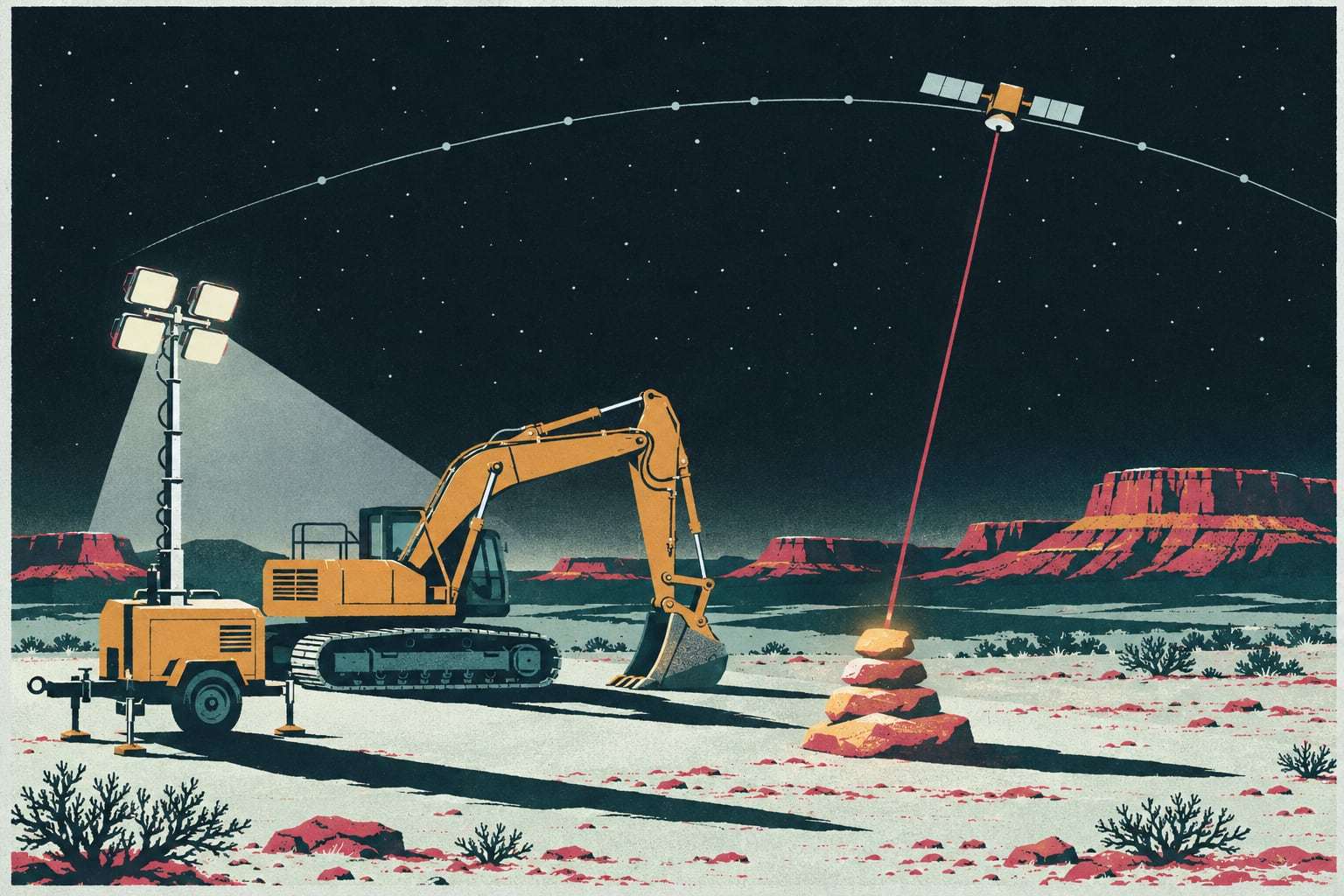
Tracking past the last cell tower
The A1S sends position, hours and faults by satellite.
- Go-live
- Live in 10 working days
- How you buy it
- A1S gateway plus satellite data
On a lease road 40 miles from the nearest tower, a cellular tracker goes quiet until the machine returns to town. The A1S keeps reporting: position, hours and active fault codes by satellite every 15 minutes, and the rest when it finds cellular again.
How satellite goes live
- Days 1 to 2
Map the dead zones
We mark which jobs and lease roads lack coverage and choose the machines that need an A1S.
- Days 3 to 5
Ship the gateways
A1S gateways are registered to your account, bench tested and shipped to your yard.
- Days 6 to 8
Fit under open sky
Installers fit each A1S where its antenna sees open sky, then confirm GPS and a first satellite message.
- Days 9 to 10
Test the fallback
We run a no-signal test, check that alerts reach the right phones and set geofences on the remote jobs.
What arrives from the ridge
- Who it is for
- Remote jobs, leases and ridge-top builds
- A1S gateways fitted and tested on the machines that work beyond coverage
- Position, engine hours and active fault codes by satellite every 15 minutes
- Geofence and after-hours alerts that keep working with no cellular signal
- Full engine data stored for 30 days on each gateway, uploaded when cellular returns
- A coverage view of which machines are reporting by satellite right now
Do your jobs need satellite?
Right for you if
- Jobs or leases sit beyond reliable cellular coverage
- You need theft alerts on remote sites, not next-day uploads
- A fault code on a remote machine should reach the shop that shift
Look elsewhere if
- Every job has solid coverage; the A1 already stores 30 days offline
- The machine works indoors or underground, with no view of open sky
Example: a wind farm build in Torrance County
A wind farm contractor runs 28 machines along about 20 miles of ridge roads near Corona, where only the laydown yard gets a cellular signal. Excavators, dozers and a motor grader move between turbine pads every few days. Our crew fits A1S gateways to the 12 machines that work the ridge and A1 gateways to the rest. The superintendent now sees every ridge machine’s position and hours each quarter hour. When a dozer on a far pad throws a coolant temperature code, the shop hears about it before lunch, not at the end of the shift.
What travels by satellite
Satellite messages are small, so the A1S sends what you need now and holds the rest.
| Data | Sent by satellite | Held for cellular |
|---|---|---|
| Position | Latest GPS fix, every 15 minutes | The full trace between fixes |
| Engine hours | Hour meter reading, every 15 minutes | Idle hours and hour-by-hour detail |
| Fault codes | Codes active at send time, every 15 minutes | Full fault history, including codes that cleared between messages |
| Engine data | Not sent | Fuel used, temperatures, pressures and DEF level |
| Alerts | Geofence and after-hours checks on every position | No alert waits for cellular |
| Tool tags | Not sent | T1 tag reads, with time and place |
| Photos and inspections | Not sent | Sync from the crew phone once it finds signal |
Store first, then satellite
Store first, always. Every A1 and A1S writes engine data, positions and tag reads to its own memory, which holds 30 days. When cellular coverage returns, the stored record uploads in full and fills in the trace. For many jobs that is enough: you see yesterday’s hours this morning, and nothing is lost on a long day out of range.
When waiting is too slow. Some questions cannot wait for the machine to drive back into coverage. Is the excavator still on the pad at 2 a.m.? Is that fault code still active? With no cellular signal, the A1S sends a short satellite message every 15 minutes with position, engine hours and any active fault codes, so geofence and after-hours alerts keep working out on the lease.
What a satellite message leaves out. Satellite messages are small by design. Full engine data, idle detail, tool tag reads and inspection photos stay stored until the gateway or the crew phone finds cellular again, then upload without anyone touching them. The satellite link carries the headline; the full record follows when there is signal. Nothing is dropped, only delayed.
Sky view matters. A satellite antenna needs a clear view of open sky. Installers fit the A1S where nothing overhead blocks it, usually on or near the cab roof, and confirm a first message before they leave the machine. Under a bridge deck or inside a shop building, the A1S simply stores and waits. The device specs sit with the rest of our tracking hardware.
Satellite tracking questions, answered
How does satellite equipment tracking work without cell service?
The A1S gateway switches to satellite when it loses cellular. Every 15 minutes it sends the machine’s position, engine hours and any active fault codes. Everything else, including full engine data, is stored for up to 30 days and uploads automatically once the gateway is back in cellular coverage.
How is satellite tracking priced?
Satellite data is a flat monthly charge per gateway, on top of the machine’s plan. The A1S gateway is bought once and owned by you, with a three-year replacement warranty. Installation is charged per machine when our crew fits it. After a walkthrough on your own fleet, the written quote shows each figure within two business days.
Can we put satellite on only some machines?
Yes, and that is how it is meant to be used. Fit the A1S to machines that work beyond coverage, such as those on remote leases or ridge-top builds, and the standard A1 to the rest. Both read the same engine data and appear on the same map.
Do after-hours and geofence alerts work over satellite?
Yes. Each 15-minute satellite position is checked against the job’s geofence and working hours, so an after-hours move or a machine leaving the job still raises an alert. Expect that alert within one 15-minute message cycle, not the moment the tracks start turning.
Will the A1S send photos or full engine data by satellite?
No. Satellite messages carry position, engine hours and active fault codes only. Full engine data, tool tag reads and inspection photos are held on the gateway or the crew’s phone and upload in full once cellular returns. Nothing is lost while it waits, because the A1S stores 30 days.
Show us where the signal stops
Send your fleet list. We will show satellite tracking on your own machines and quote it in writing.