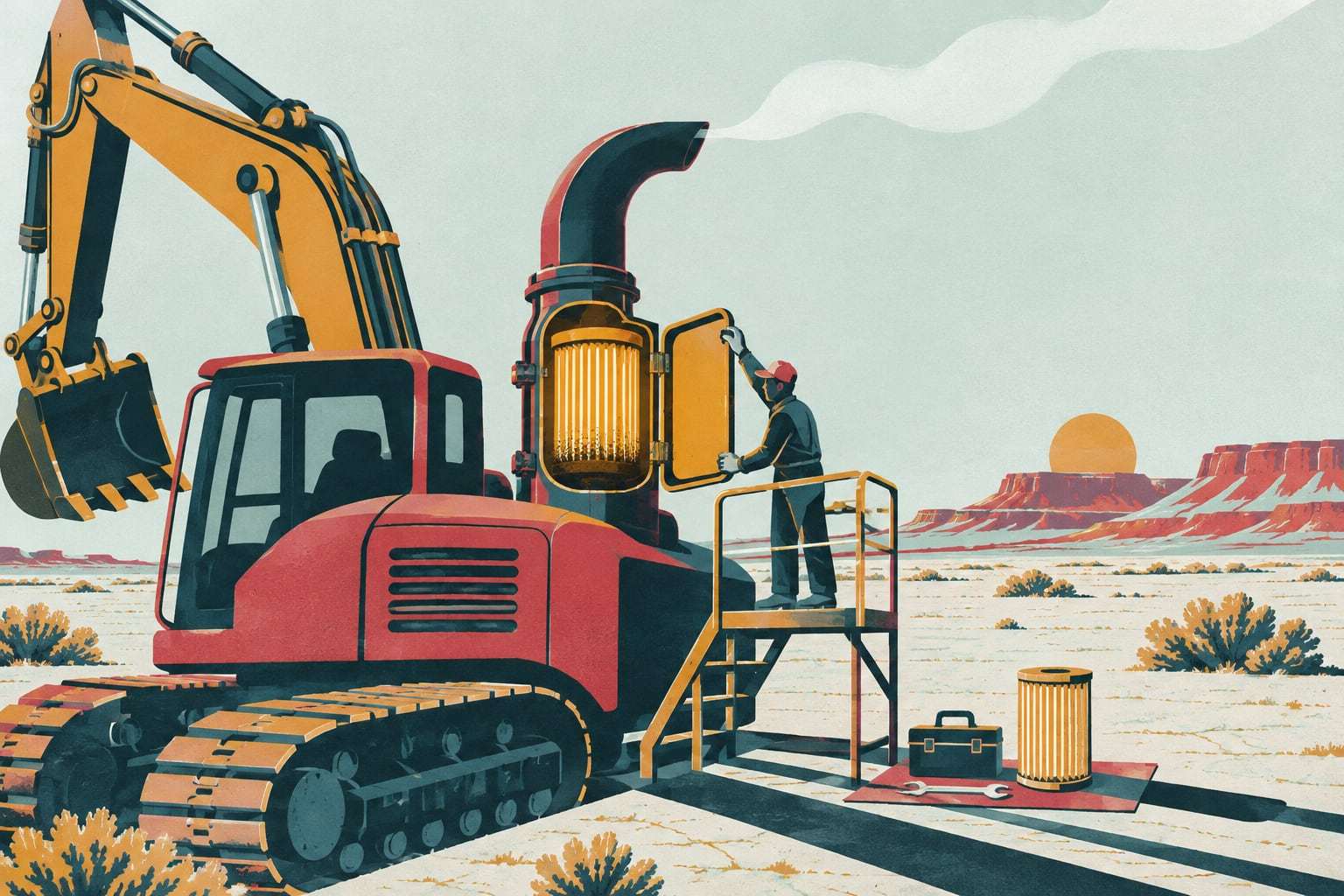
Tier 4 Final turned the exhaust into a maintenance system with its own fluid, filters, sensors and fault codes. Most aftertreatment trouble starts with how a machine is worked and how its DEF is handled, long before a part fails.
What Tier 4 Final added
The EPA adopted Tier 4 emission standards for nonroad diesel engines in 2004, phased in from 2008 to 2015. Final is the last stage of that phase-in, and it brought exhaust aftertreatment to most mid-size and larger diesel machines.
Depending on the engine and its power rating, a Tier 4 Final machine may carry:
- DOC. A diesel oxidation catalyst that cleans up some exhaust gases and helps heat the exhaust.
- DPF. A diesel particulate filter that traps soot.
- SCR. Selective catalytic reduction, which uses diesel exhaust fluid to cut nitrogen oxides.
- EGR. Exhaust gas recirculation, used on some engines to lower combustion temperature.
Not every machine has all four. Some engines meet the standard without a DPF, and some use SCR without EGR. The operator’s and service manuals for each model are the authority on what is fitted, how it regenerates and what it needs. Everything below is general; where it differs from your manual, the manual wins.
For an equipment manager, that adds three things to manage: a fluid to buy, store and dispense; a filter that depends on how the machine is worked and needs periodic ash service; and a family of fault codes that can cut a machine’s power in the middle of a shift.
How DPF regeneration works
A DPF fills with soot as the engine runs. Regeneration burns that soot off by raising exhaust temperature. Manufacturers name the modes differently, but most systems use three:
- Passive. During hard work, exhaust runs hot enough to burn soot without help.
- Active. The engine control raises exhaust temperature while the machine keeps working, usually by adding fuel or changing engine settings.
- Parked. The operator parks the machine and starts a regeneration that runs at raised idle for a set time.
If parked regenerations are skipped or inhibited for too long, some systems require a service regeneration with a diagnostic tool, or removal of the filter for cleaning. Either one takes the machine out of work.
Ash is different from soot. It comes mainly from additives in engine oil, it doesn’t burn, and it builds up until the DPF is cleaned or replaced at the interval in the manual. Using the low-ash oil specification the manual calls for slows that buildup.
Regeneration exhaust is hot. Manuals warn against regenerating near dry grass, brush or fuel, which in a New Mexico June means checking where the machine is parked before pressing the switch.
Why light duty loads the filter
A machine that works hard all day regenerates passively and rarely bothers anyone. A machine that idles, travels or does light work never gets its exhaust hot enough. Soot builds, active and parked regenerations come more often, and operators start inhibiting them to keep working.
That pattern shows up on standby loaders, excavators used mostly to set pipe, and machines kept running for cab air on hot afternoons. It is a duty cycle problem that looks like a filter problem.
Hours between parked regenerations = engine hours in the period ÷ parked regenerations in the period
Worked example. Two loaders of the same model each ran 200 hours last month. Loader A needed 2 parked regenerations, one every 100 hours. Loader B needed 10, one every 20 hours. Loader B spends most of its day feeding a screen at low load and idling between trucks. Before replacing a sensor or a filter on Loader B, look at its idle ratio and its duty.
Decision rule. If a machine needs parked regenerations far more often than others of its model, check duty cycle and idle first, then sensors, then the filter. Sometimes the cheapest fix is swapping it with a machine that works harder.
Keep DEF clean and fresh
Diesel exhaust fluid is a high-purity blend of urea and deionized water, made to a fixed concentration. Small amounts of contamination can damage the SCR system, so DEF needs more care than most fluids in the shop.
- Dedicated equipment. Use DEF-only containers, pumps, nozzles and funnels. Never borrow one that held fuel, coolant or oil.
- Closed dispensing. Fewer open transfers mean less dust in the fluid, which matters in a caliche yard.
- Watch the cap. DEF tank caps are usually blue. If diesel goes into a DEF tank, don’t run the machine; drain and flush as the manual directs.
- No water top-offs. Diluting DEF to stretch it causes quality faults and damage.
- Shade and dates. Heat shortens DEF shelf life. Store it out of direct sun, not in a steel box in a July yard, and use stock in date order.
- Cold weather. DEF freezes at about 12°F. Machines are built to thaw it, but stored totes and jugs on a winter job in southern Colorado need a plan.
- Compatible materials. DEF attacks some metals, including copper and brass, so dispense it only through equipment made for it.
Buy only what you will use while it is fresh.
DEF to keep on hand = DEF used per week × weeks of supply
Worked example. Twenty machines on a job near Deming use about 5 gallons of DEF each a week, so 100 gallons a week. With deliveries every two weeks, 200 gallons on site covers the gap plus a little margin. A full summer’s supply bought in May would sit in the heat for months.
Faults and derates to watch
Aftertreatment problems usually announce themselves through fault codes before they stop a machine. The common families are:
- DEF level low
- DEF quality or concentration
- DEF dosing or pump faults
- NOx sensor faults
- DPF differential pressure or soot load high
- regeneration inhibited or incomplete
- exhaust temperature sensor faults
Most systems escalate: a warning, then reduced power, then a severe derate that limits the machine to low idle or low speed. The steps and their timing differ by manufacturer and are set out in the manual. Each code arrives as an SPN and an FMI, which our guide to reading J1939 fault codes explains.
Decision rule. A DEF level warning is an operator fix at the next fuel stop. A DEF quality, dosing or NOx sensor fault goes to the shop the same day. A derate goes to the shop lead immediately, because the machine is about to stop working.
Asset health monitoring puts those codes in front of the shop with the machine’s hours, location and recent history. A mechanic can tell whether the loader at the pit is on its first DEF quality code or its fifth before driving out.
Put aftertreatment on the PM plan
Aftertreatment tasks belong on the same schedule as oil and filters, by engine hours, with intervals from the manual for each model:
- DEF tank filter, doser filter and tank breather
- DPF ash cleaning or replacement
- Crankcase ventilation filter, where fitted
- Engine oil to the low-ash specification in the manual
- Air intake inspection for leaks, which matters on dusty jobs
- Sensor and harness inspection near hot exhaust parts
- Ultra-low sulfur diesel only, which Tier 4 engines require
Preventive maintenance carries these as tasks inside each model’s 250, 500, 1,000 and 2,000 hour plans, and opens the work order before the interval with the filters on the parts list.
Track DEF use against fuel use for each machine, too.
DEF ratio = gallons of DEF used ÷ gallons of diesel used
Compare each machine with its own history and with others of the same model, not with a number from a forum. A sudden change in that ratio, with no change in the work, is worth a look before it becomes a fault code.
Train operators at the machine
Operators decide most of what happens to a DPF. A short session at the machine should cover:
- what the regeneration lights and messages mean on that model
- when to let a regeneration finish, and when to start a parked one
- where not to park during a regeneration
- the difference between the DEF filler and the fuel filler
- who to call when a derate warning appears
Do it in English and Spanish, at the machine, and repeat it whenever a new model arrives.
Mistakes that cost an SCR system
- Diesel in the DEF tank. One wrong nozzle at 6 a.m. Label tanks and nozzles clearly.
- Hot storage. A summer’s supply of DEF baking in a shipping container.
- Shutting down mid-regeneration. Turning the key off during a regeneration leaves the job half done.
- Inhibit as a habit. Operators who always press inhibit eventually get a service regeneration or a derate.
- Clearing codes. Clearing a code without fixing the cause brings it back, usually at a worse time.
- Tampering. Removing or disabling emissions equipment is prohibited under federal law. It isn’t a repair option.
Keep codes and service together
Aftertreatment is easier to manage when fault codes, hours and service history sit together. Asset health monitoring and preventive maintenance are both in the Shop plan. For terms like DOC, SCR, regeneration and derate, the fleet glossary has short definitions.